

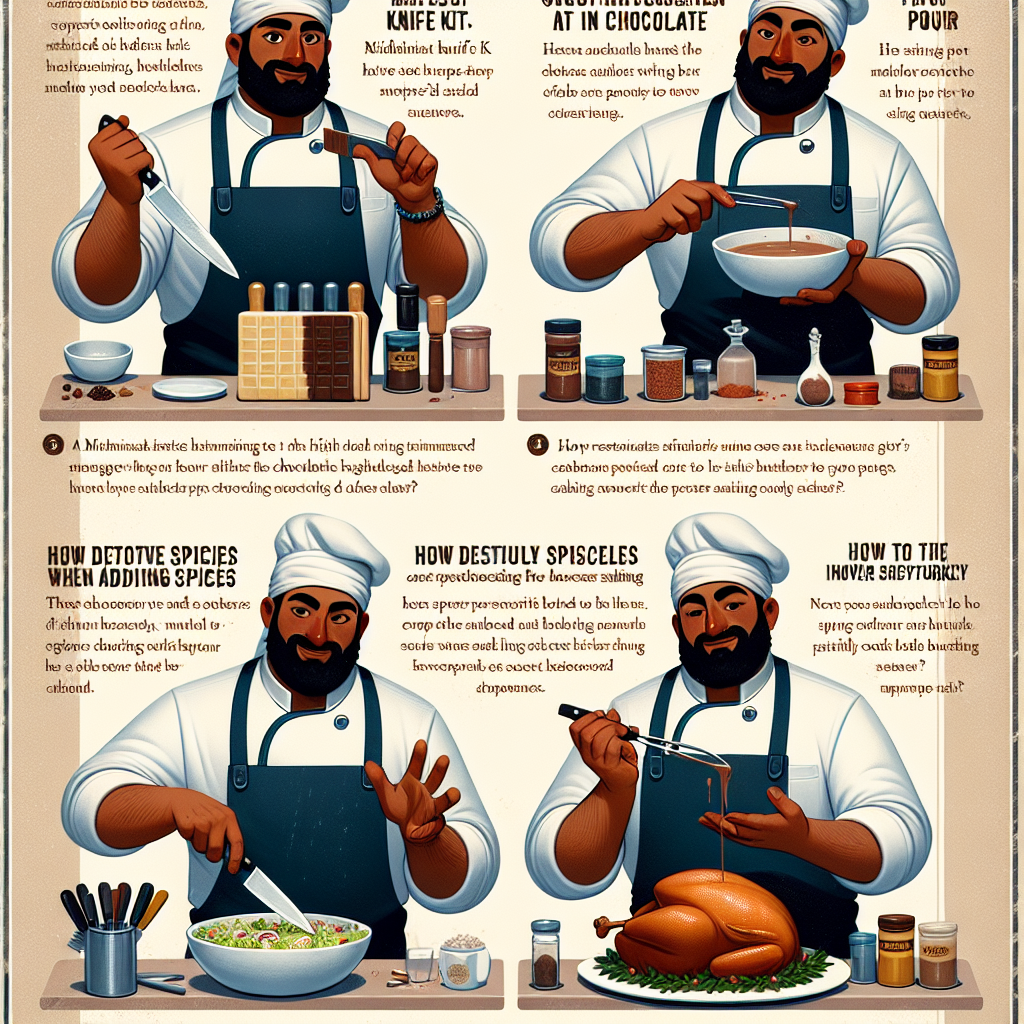
 # Kitchen Confessions: Knives, Caesar Hacks, Spiced Chocolate, and the Butterball Question
Every week a new kitchen mystery finds its way into my inbox — and honestly, that’s my favorite kind of mail. These questions are the small, practical puzzles that make feeding people easier and more joyful. Think of this column as a friendly potluck of tips: short, useful, and just the sort of thing you can do between school pickup and dinner.
I’ll walk through four favorites today: what knives you really need and how to keep them useful, why you might want to thin your Caesar (and how pros do it), how to add warming spices to tempered chocolate without wrecking it, and whether you can remove a Butterball wrapper to spatchcock and brine. I’ll explain not just the how, but the why — because once you get the principles, the cooking gets easier.
## Knife talk: what you really need and how to care for it
You don’t need a shrine of knives to cook well. Start with three reliable tools: an 8–10″ chef’s knife for most chopping, a small paring knife for trimming and detail work, and a serrated bread or tomato knife for anything with a crust or delicate skin. That covers 90% of home prep.
Why these three? Versatility and safety. A good chef’s knife lets you use a rocking motion for fast, controlled cuts; a paring knife handles tasks where precision matters; and a serrated blade slices soft or crusty surfaces without crushing them.
Care basics (the why):
– Hone regularly. A honing steel doesn’t sharpen metal away; it realigns the edge. Doing it every few uses keeps the knife safer and smoother to cut with.
– Sharpen occasionally. Real sharpening removes metal and restores the correct edge geometry. Once or twice a year is enough for most home cooks — more if you cook daily.
– Store correctly. Loose in a drawer dulls and chips edges and is a safety hazard. Magnetic strips or sheaths protect edges and hands.
– Buy well. A mid-range, well-made knife will out-perform a set of cheap blades and teach you good technique.
Teach older kids basic knife safety — hold the handle, tuck fingers into a “claw,” and let them do simple tasks like slicing fruit. A sharp knife is actually safer because it’s more predictable.
## Lightening your Caesar: how restaurants get that thin, bright pour
The trick restaurants use is simple: keep the flavor, lose the heaviness. At the heart of Caesar is an emulsion (oil + egg, stabilized by mustard and the proteins in egg yolk). A dense emulsion will feel heavy; loosen it and the salad breathes.
Quick techniques and the reason they work:
– Use pasteurized egg or a tablespoon of mayonnaise. This keeps the emulsion stable while eliminating raw-egg risk.
– Swap in a lighter oil (grapeseed, light olive oil) or reduce total oil. Less oil = less richness.
– To thin without breaking the emulsion: whisk in warm water, one tablespoon at a time. The warm water loosens the matrix and thins the dressing without separating it.
– For a silkier, lighter mouthfeel, add buttermilk or whole milk. Dairy thins while adding body and tang.
– Brighten with acid — a bit more lemon or a splash of white-wine vinegar opens the flavors.
A quick tweak: 1 egg yolk (or 1 tbsp mayo), 2–3 tbsp lemon juice, 1–2 anchovies or anchovy paste, 1 tsp Dijon, 1 clove garlic, slowly whisk in 1/3 cup light oil. Thin with 2–4 tbsp warm water or 2 tbsp buttermilk; season to taste.
Why it works: emulsions rely on balance. Small amounts of liquid or dairy change the mouthfeel without losing the salty, umami backbone that makes Caesar craveable.
## Spiced tempered chocolate: when and how to add flavor without breaking the temper
Tempered chocolate has a specific crystalline structure that gives it snap and sheen. Water, grit, or oily solids can ruin that structure and make the chocolate dull or grainy. That’s why “don’t add wet spices directly” isn’t just kitchen superstition — it’s physics.
Safer ways to add spice:
– Infuse the fat. Warm cream or neutral oil with whole toasted spices, steep, then strain. Add the flavored fat to your chocolate — perfect for ganaches and fillings.
– Make a spice tincture. Toast spices, warm them slightly, steep in a neutral spirit, then strain. A few drops after tempering add aromatic lift without introducing water.
– Cocoa-butter infusion. Melt cocoa butter with whole spices, steep and strain, then blend into your chocolate before final temper adjustments. This is ideal when making bars or coated confections.
– If you must use ground spices, mill them extremely fine and test a small batch. Powders can change texture and color.
The key principle: keep moisture away from the molten chocolate’s crystal network. Infusing a dry fat or using an alcohol-based extract keeps flavor while protecting temper.
## Butterball turkey: can you remove the wrapper and spatchcock?
Short answer: yes — but be safe about it. Packaging warnings often assume conventional whole-roast instructions or are there to prevent contamination during transport. If you plan to spatchcock (butterfly) and brine, remove the wrapper, keep the bird cold, and follow safe handling.
Practical steps and why they matter:
– Thaw in the fridge, not on the counter. Cold, slow thawing keeps bacterial growth minimal.
– Remove giblets and pat dry before brining or seasoning. Excess moisture dilutes brine and prevents crisp skin.
– Choose dry brining for simplicity: rub kosher salt (and aromatics) under and over the skin, refrigerate on a rack. Dry brining firms the skin and concentrates flavor without needing a large container.
– If wet brining, use a refrigerator-safe container or a cooler with ice. Keep the temperature below 40°F.
– Spatchcocking evens cooking and shortens roast time; it’s perfect for a busy household wanting juicy dark and white meat.
– Always use an instant-read thermometer. Aim for 165°F in the thickest part of the breast and thigh for safety; carryover will even out the temperature while the bird rests.
Why spatchcock? The bird lays flat, more surface area browns, and you avoid overcooking the breasts while waiting for thighs to finish.
## Takeaway
Cooking is a series of small decisions that add up to success. Keep a simple, well-cared-for knife kit; learn the science behind emulsions to loosen a heavy Caesar without losing flavor; protect tempered chocolate by infusing fats or using tinctures for spices; and feel confident removing poultry packaging to spatchcock and brine — just keep the bird cold and use a thermometer.
Now I want to hear from you: which one of these small kitchen experiments will you try this week — teach a teen to hone a knife, lighten your Caesar for salad-night, temper a spiced ganache, or spatchcock your next turkey?

